

The Transformations Club First Meeting
Six types of members are described in the Beginning section below. Each one is very important to us no matter the level of experience or commitment. This packet includes material for all levels. You may want to just look at those parts relevant to how you feel.
Beginning
Each person who receives this packet might be interested in this page.
1. Inactive (those who did not come to the meeting but have not asked to be removed from the list):
Please let us know if you plan to attend the next meeting in person or on Zoom
2. Beginner (people at the meeting):
We are the Club Beginners. Barbara said it well after each person introduced themselves and their backgrounds: “What a fascinating group of people! I wouldn’t mind being stuck in the elevator with any of you.”
transformations@guide2expertise.org
People who intend to come to the next meeting might want to read the Exploring Section
3. Explorer: We will begin our next meeting by exploring your comments and questions on the Founding Meeting, as well as what you liked, and would like to improve.
People who already feel committed to keeping the Club going will want to comment on the Sustaining section.
4. Sustainer: There is a suggestion attached below about how members could contribute in different ways.
People who want to make or respond to a contribution on a particular topic might be interested in the sustaining section..
5. Master: Several important topics were introduced at the meeting. To keep the discussion going, Group Genius author, Keith Sawyer, suggests we use the “Yes…and” approach, of affirming the comments and add to them. There are comments below on the discussion about the right and left brain. If you want to add to these comments of on another topic that we discussed, we will create a page for the topic on guide2expertise.org.
People who contribute to a group discovery or innovation might be interested in the Mastering section.
6. Inspirer: The key contributors will be involved in writing and submitting to some publication or other way of disseminating the discovery or innovation.
Exploring
Founding Members
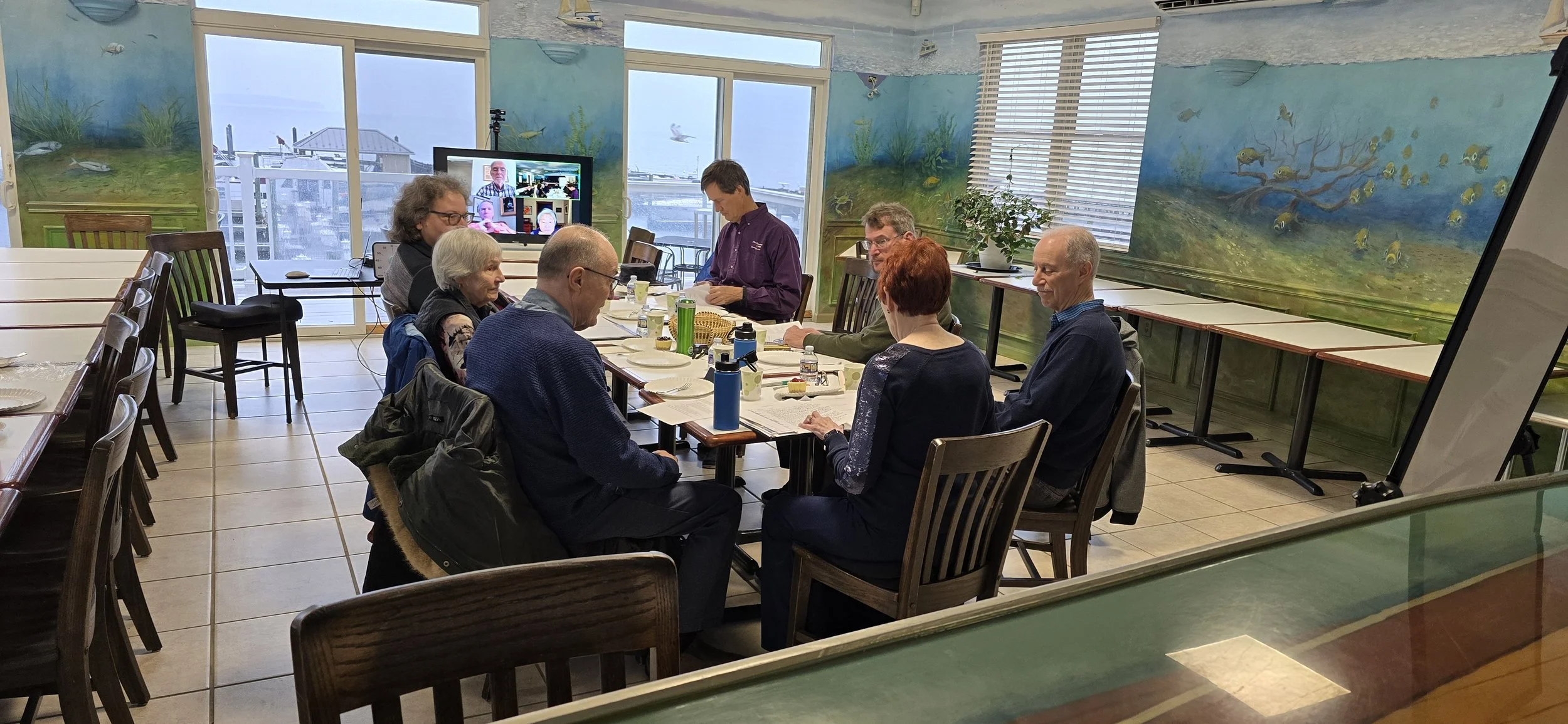
Founding Members: Counterclockwise from the table end, Sandy, Mark, Lonny, Duke, (Zoom) Judy, Michael, (continuing up the table) Barbara, Cheryl and David.
Examining Dilemmas
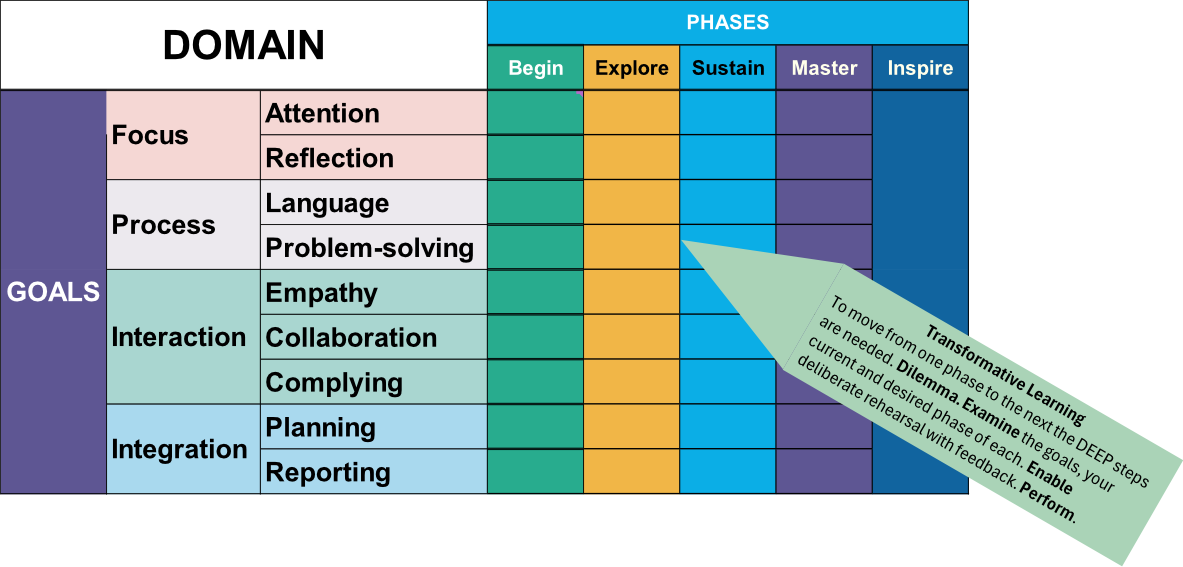
After introductions of people and the note-taking part of our meetings, we talked about dilemmas of David (educational assessment consultant) and Lonny. David’s dilemma was getting mad at the computer. The Transformations Matrix (the summary chart below) helps us use guide2expertise.org/explore to transform his mode of practice to something that works better. Key terms from the website will be in boldface type.
Feedback Questions
1. What did you learn?
There is a fascinating group of people interested in transformations that include (with Zoom and in-person members), a laboratory manager, a civil engineer, four teachers, a Reform Rabbi, three writers, researchers in toxicology and psychology, two NSA outreach officers, a counselor, and a therapeutic pianist.
2. What questions were not answered?
The way the group prefers to provide their feedback answers (e.g. notes emailed to info@guide2expertise.org, comments at the beginning of the next meeting, etc.)
3. What worked that we should continue to do?
A dilemma examination that involved one or two goals.
4. What didn’t work, and what would you suggest to improve it?
The timing. A dilemma that involved more than two goals.
Plans
1. What topic would you like to have us discuss sometime in the future?
Cheryl proposed a dilemma she would like to discuss.
2. What topic would you like to introduce sometime in the future?
Notes on Examining a Dilemma
The first step of transformative learning is to discern a dilemma. Next, we examine the dilemma and this is where the diagram becomes a powerful tool that gets us to the answers much quicker than we could without it. Examining with the website and the summary chart begins by identifying the domain of the activity by making three choices:
1. Is it work or life?
2. Does it involve survival, wellbeing, or significance?
3. Is it short-term, midterm, or long-term.
David mentioned that even though he used the computer for work, getting mad at it was just at home, so we are talking about a life issue. Getting mad is not good for one’s health, so it is also a wellbeing issue. Since it only lasts for a fraction of a minute, it is also short-term.
Next, he decided that there were two goals involved. The first one had to do with attention, which refers to focusing on the immediate use of sensorimotor parts of the brain. When he places his fingers on the keyboard, he just explores and often ends up typing gibberish or worse, activating some function that makes a major change in what he is looking at.
To use a sustainable mode of practice, he could attend to the f and j keys with the little bumps on the keyboard and place his index fingers on them. While drafting this packet, he reported that this simple approach has made a big difference.
David’s other goal had to do with planning. When he is under time pressure, the problem is worse. Currently, he chooses to use the computer often on a whim or in response to a request. He doesn’t think about how long his use will take or what might happen if he can’t finish. So, like the finger placement, those are exploratory modes of practice. Making them deliberate is more sustainable. So, before opening the computer, he needs to remember to decide how long it will take and what he should do if he can’t finish.
We also began discussion of Lonny’s dilemma: how should he use his precious free time? He decided first that it involved a life domain that affected his wellbeing over a mid-term. As we began to examine this dilemma, he pointed out that it involved focusing on reflecting, interacting with empathy, and integrating by planning. For each of these goals he would like to change his haphazard, exploratory mode of practice to a sustainable mode.
Sustaining
Avoiding Storming-Phase Conflicts
Dan mentioned Tuckman’s Stages of group formation:
1. Forming (our first meeting),
2. Storming,
3. Norming,
4. Performing.
5. Transforming (a fifth phase added by Praxomics).
Praxomics includes them as the phases of collaboration.
We formed (the beginning phase) on Saturday. The next phase (Storming) may not be necessary. The SCAD (Savannah College of Art and Design) faculty’s emphasis on division of labor as the phase after storming, suggests that we could minimize the conflicts of the storming phase by choosing roles. Below are some ideas based on the 9 goals.
Each goal would need to be fulfilled at each meeting, so if you feel inclined to help with more than one role, it would further the Club’s development. As we grow, having several people in each role would also be helpful. Members who fulfill a role can start at any phase, so beginners and explorers need to spend little time in a role. As the Club matures, more advanced modes of practice will become more common.
Proposed Roles Based on the Nine Goals
For the Goals see the Chart under Explore, above
FOCUS ROLES
Attention Goal: Choose what to sense Goal: to look at, listen to, touch, smell, or taste, and actions needed in response to them.
Tech for Zoom and presentation material (before and during meetings, manage Zoom and help presenters create text and images to share)
Reflection Goal: Turn off attention in order to focus inside by choosing memories of prior experiences or imagining possibilities.
Investigator (use memory, AI, or other sources to find connections to common ideas or practices like Tuckman’s Stages of Group Formation, Mazlow’s Hierachy of Needs, Roger’s Person Centered Psychotherapy, etc.).
PROCESS ROLES
Language Goal: Speaking to or comprehending others using shared symbols.
Word expert (take notes on terminology problems and send conclusions to recorder)
Problem solve Goal: Modify reactions to new situations in order to reach satisfying outcomes.
Facilitator (ensure roles are fulfilled and propose ways to improve meetings)
INTERACTION ROLES
Empathy Goal: Infer and predict the beliefs, thoughts, intentions, and emotions of others.
Member supporter (find potential new members and support current members before and after meetings)
Collaboration Goal: Accomplish satisfying outcomes that cannot be achieved without another person.
Presenter organizer (make sure that we have one or two presenters and topics for each meeting)
Compliance Goal: Select practices that are widely observed and accepted in a culture and sometimes codified in laws or well-known maxims.
Rule manager (clarify rules of order and other roles)
INTEGRATION ROLES
Planning Goal: Remember and sequence practices in order to achieve a satisfying outcome.
Planner (prepare agendas and sometimes propose other activities)
Recording Goal: Use language or technology to organize and preserve experience for later use by oneself or other people.
Recorder (collect and summarize for posting to the website personal notes from participants and special notes from those with one or more of roles above).
Mastering
Learning and the Brain:
Attention vs. Reflection and Automatic vs. Deliberate Practice
1. The Expert's Secret: Shifting Gears
Experts don't just work harder; they shift between two mental gears: Deliberate Practice (the hard work of learning something new) and Automatic Flow (using what they already know perfectly).
New Tasks (Deliberate): When an expert learns something new, they use their "Inner Critic" (the front of the brain) to pay intense attention. This is exhausting and slow.
Mastered Tasks (Automatic): Once a skill is mastered, the brain moves that task from the "thinking" centers down to the Basal Ganglia—the brain’s "autopilot" (sometimes called the "reptilian brain" because it's so fundamental). This is fast, efficient, and feels like "flow."
Key Principle: True expertise requires the ability to dance between these two. You use your "autopilot" for the basics so your "thinking brain" is free to innovate and solve new, harder problems.
2. Beyond "Left Brain vs. Right Brain"
The old myth says the left brain is just a calculator and the right brain is an artist. Modern science shows that experts actually use both sides in a sophisticated relay race.
The Choreographer's Example: When creating a new dance, an expert starts in the Right Brain to imagine the specific movements. But as soon as they start putting the steps in order (1-2-3-4), the Left Brain takes over, using the same logic we use to build sentences.
The Scientist's "Poet" Moment: A scientist’s brain looks like a poet's during an "Aha!" moment. This happens when they stop trying to solve a problem and the brain relaxes. By silencing the "logical" side for a moment, letting the “creative” side can find a surprise connection.
3. The Power of Focus: Inward vs. Outward
Perhaps the most important discovery is that where you look matters as much as which side of the brain you use. The two directions feel different:
Attention focuses on sensorimotor processes such as Learning a new skill; listening carefully; "Deliberate" work. Choreographers’ integration of movements into whole dances. Scientists making and recording observations.
Reflection focuses inward Thinking deeply; the "Default Mode Network" turns on; connecting new ideas to old memories. Choreographers. Creations of specific movements. Scientists connecting observations with previously unrelated ideas to create new insights.
To reflect deeply, the brain needs to suppress the world around it. This is why experts often "stare into space" when they are doing their most profound work—they are turning off the outside world to navigate their inner libraries.
4. How to Identify an Expert
If you are trying to understand someone who is much more advanced than you, keep these three things in mind:
They make it look easy because it IS easy (for them): Things you have to think about step-by-step, they do on "autopilot." Because their brain is so efficient, you might not even "see" the work they are doing.
They are Whole-Brained: They aren't just "creative" or "analytical." They are constantly switching between the two depending on what the moment requires. People who are inexperienced at any activity tend to isolate activity in particular parts of the brain. Beginning piano players tend to pick out melodies with their dominant hand. When they add harmony with their other hand more of their brains are involved. When masters integrate multiple melodies, harmonies, and rhythms into new compositions, wide parts of the brain are involved.
They use "Selective Quiet": An expert knows when to turn off their inner critic to let a new idea breathe, and when to turn it back on to polish that idea into a finished product.
5. Evolution and Assessing Expertise
E volution is a temporary rebellion against decay. Evolution of competing practices into locally more complex systems happens at all levels from plasmids (sections of DNA) to parts of the brain (attention vs. reflection), group formation, and ecosystems, but so does the universal trend toward increasing disorder (chaos, as Sandy pointed out).
Expertise is our answer to decay. Collaborative groups use the different types of expertise in their members to evolve more complex ideas.
Standardized testing, whether for skills or personalities, and numerical ratings or grading on the curve fixates people or performances at a single point in time. Praxomics focuses on measuring change over time.
It creates better understanding and leads to more effective collaboration to discover what others know that we do not than to focus on limitations like imagining what people with different types of expertise from us can’t do that we can or limiting ourselves to what we can't do that they can.