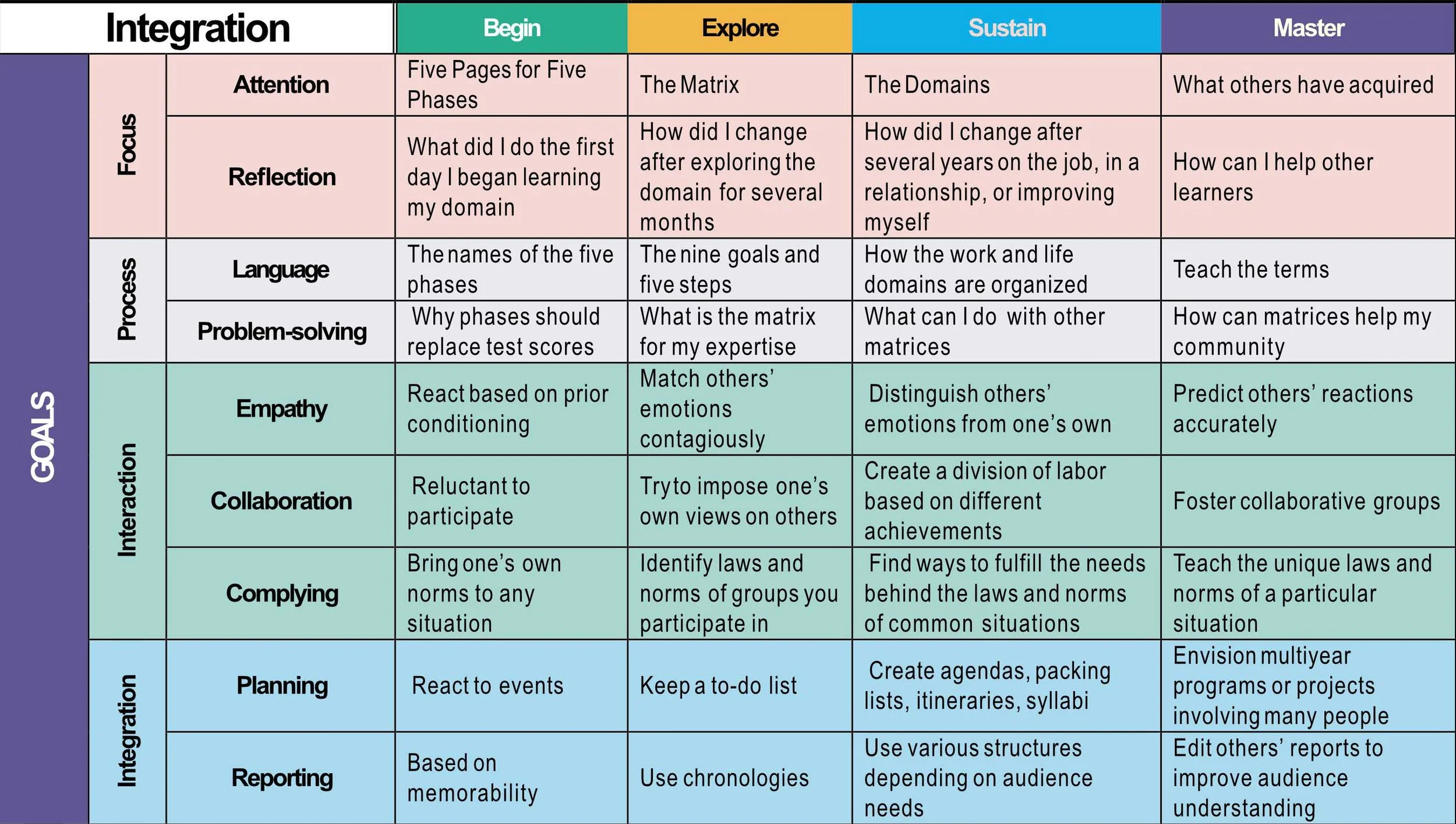
Domain MatricesT
The core metrics for evaluating machine learning are known as the EAST variables, standing for Efficiency, Accuracy, Scability, and Transferability. These have been the mainstay of the proxemics-project for decades.
The first publication in the project was the 1972 article on Most Efficient Chunk Sizes, which showed that memory searches are most efficient when we group items in sets of 2 to 4.
We emphasized accuracy when we created the 1978 manual for coding drawings on six goals each and trained 3 independent raters to agree at least 85% of the time for each goal.
Transferability was first shown when we provided the Theoretical Framework in 1980 for “The 2nd R,” which was used to train the evaluators for the New York State Regents Exam in Writing. Since 2014, the framework has been used nearly 3,000 times to code the development of music expertise in students.
An example of how the project addressed scability was our analysis in the late 199of 912 developmental research papers published between 1930 and 1992. It turned out that the succession model described on the Inspire page described that historical development as well as it did the individual development of drawing, writing, and musical skills.
Another example of scalability comes from our application of the nine goals to each of the four systems of goals. Thus, in addition to the Work and Life Domains, we will illustrate how the systems interact by providing matrices for each of the four systems: Focus, Process, Interaction, and Integration